

You visit the site once in a while.
Cement bags are stacked. Steel rods are lying there. Bricks are arranged.
Everything looks fine.
But here’s the real question:
Are those materials actually good quality? Or are you just hoping they are?
Most Indian homeowners don’t know the difference. And that’s exactly where problems begin.
The Hidden Fear Every Homeowner Has
- “Are they using the cement brand I approved?”
- “Is this steel really TMT 550D?”
- “Are they mixing sand properly?”
- “Are they reducing cement quantity to save cost?”
You may trust your contractor.
But construction is not about trust alone.
It is about systems, supervision, and accountability.
Why Material Quality Gets Compromised
Let’s be honest.
Material cheating doesn’t always happen because someone is “bad”.
It happens because:
- There is no technical supervision
- There is no documented specification
- There is no on-site verification
- The homeowner cannot visit daily
- The contractor is trying to manage margins
And slowly, small compromises happen:
- Slightly lower grade steel
- Extra sand in concrete mix
- Cheaper plumbing fittings
- Lower thickness tiles
Individually small.
Collectively dangerous.
What Poor Material Quality Actually Costs You
It’s not just about money.
It’s about:
- Cracks in 2–3 years
- Leakage during monsoon
- Structural weakness
- Higher maintenance
- Reduced property value
You build a house once.
But poor materials keep punishing you for decades.
So How Do You Actually Ensure Quality?
Here’s what most homeowners miss 👇
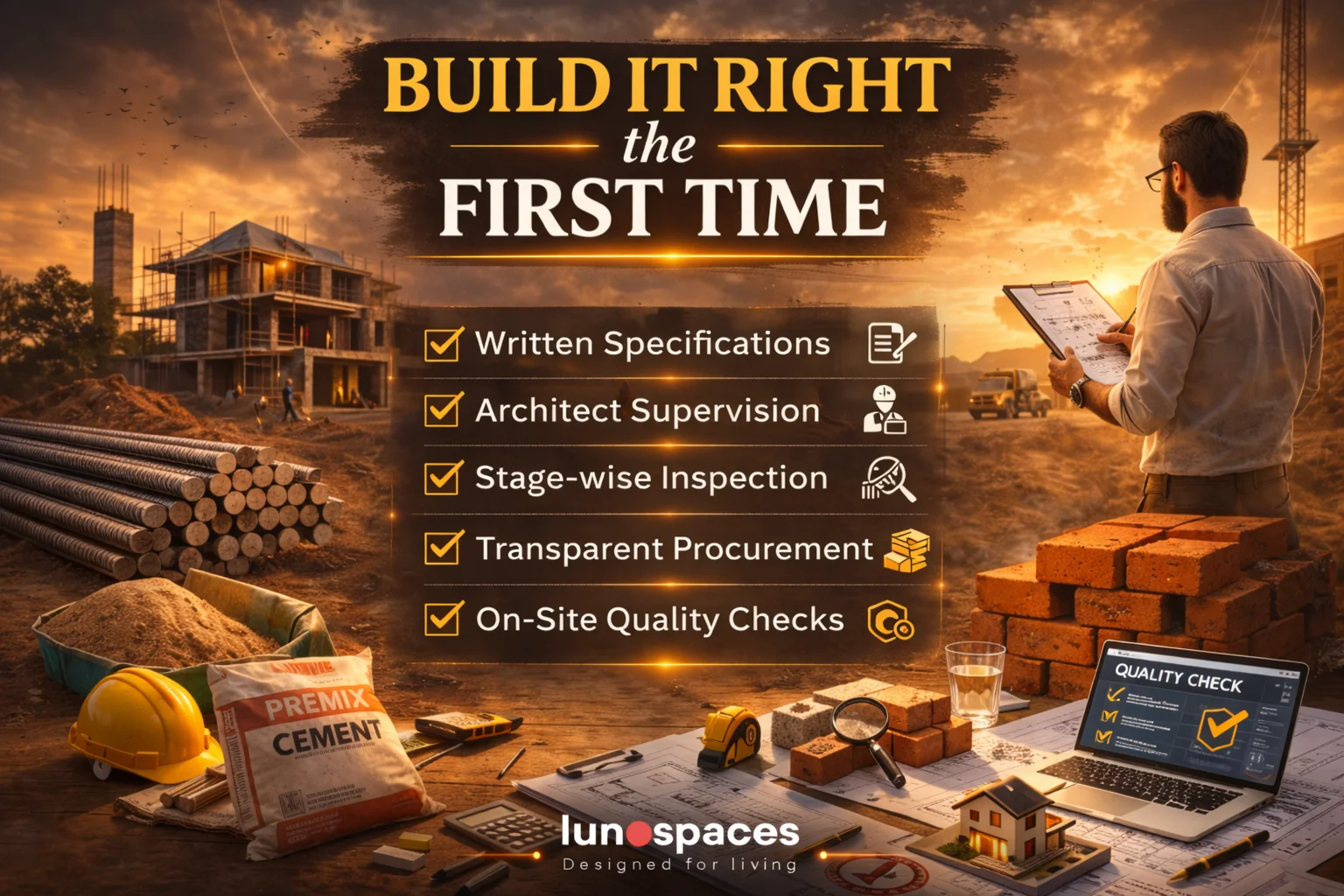
1. Written Material Specifications
Before construction starts, there must be a clear material list:
- Cement brand
- Steel grade
- Brick type
- Plumbing brand
- Electrical wiring brand
If it’s not written, it’s flexible.
If it’s flexible, it can change.
2. Regular Site Supervision by a Qualified Architect
A mestri checks work.
An architect checks standards.
There’s a difference.
A qualified architect:
- Verifies materials delivered
- Checks mix ratios
- Inspects curing quality
- Ensures drawings are followed
Without technical supervision, quality becomes guesswork.
3. Stage-wise Inspection
Foundation stage
Slab stage
Brickwork stage
Finishing stage
Each stage needs inspection before moving to the next.
Once concrete is poured, you cannot undo it.
4. Transparent Procurement System
- Who is buying materials?
- Are invoices shared?
- Are brands matching specifications?
- Is there photo documentation?
Transparency removes doubt.
5. No “We’ll Adjust on Site” Decisions
Most quality loss happens when someone says:
“Sir, same untundi… we’ll adjust.”
Adjustments in construction usually mean compromise.
The Real Truth
If you are not from a construction background,
you cannot monitor all this alone.
And you shouldn’t have to.
That’s exactly why architectural supervision exists.
Not for luxury.
Not for show.
But for protecting your investment.
At LunoSpaces, Here’s What We Do Differently
We don’t just design.
We:
- Define material specifications clearly
- Conduct structured site visits
- Ensure plan-to-execution consistency
- Monitor quality at every stage
- Maintain transparency in process
From vacant land to key handover, quality is not assumed.
It is controlled.
Building a home is a once-in-a-lifetime decision.
Don’t leave material quality to chance.
If you’re planning construction, talk to LunoSpaces before you begin.
📞 Call LunoSpaces
💬 WhatsApp the team
📝 Or fill out an enquiry form
Let’s build it right — from the foundation itself.




Join The Discussion